
TECH
How Nexus AlienSync Redefines AI Orchestration


At its core, Nexus AlienSync is an AI orchestration platform designed to automate and coordinate data, events, and AI model updates across different systems. Unlike classic middleware that just slings messages, AlienSync “understands” events, adapts sync logic, and optimizes for latency, consistency, and scale.
You can think of it as your sync conductor: the platform that ensures each instrument (database, model, API, service) plays its part in harmony, with minimal human glue code.
Key pillars include:
- Intelligent connectors that adapt to changes in schemas or endpoints
- A sync orchestration engine that reasons about order, dependencies, and failure
- Adaptive synchronization logic that learns from past flows
- Built-in APIs, webhooks, and a no-code integration layer for non-engineers
Let’s see how those parts come together.
The Core Architecture
Microservices & Event-Driven Sync Architecture
In modern stacks you tend to see microservices with their own databases or bounded contexts. When something changes in Service A, you must propagate that change to Services B, C, analytics, and perhaps AI models. Nexus AlienSync supports microservices event-driven architecture, listening to domain events (via Kafka, RabbitMQ, event bus) and applying intelligent rules to decide how and when to sync.
Instead of “dumb” fan-out, it builds dependency graphs, enqueues tasks, retries on failures, and ensures data consistency across systems.
Integration Framework & System Integration Middleware
It’s tempting to use old-school system integration middleware to bridge systems. But those tools often have brittle mapping rules. AlienSync provides a modern integration framework that supports schema mapping, transformation pipelines, versioning of sync logic, and rollback support.
API Orchestration + Connectors
Many systems expose APIs. AlienSync wraps those into API orchestration flows—e.g. calling System X’s REST API, transforming the JSON payload, then pushing to System Y. The intelligent connectors detect changed fields or schema additions and auto-remap when possible, reducing maintenance burden.
Hybrid Cloud & Multi-Cloud Sync
When you run part of your infrastructure in AWS, another in Azure, and maybe some on-premises, hybrid cloud sync is essential. AlienSync handles multi-cloud sync, routing data across boundaries, securely tunneling, managing retries, and balancing latency vs throughput.
Machine Learning Model Sync & Adaptive Logic
Beyond raw data, your ML models themselves need updating. AlienSync can trigger machine learning model sync—propagating updated model weights, feature embeddings, or inference endpoints across clusters. Because it’s adaptive synchronization, future sync tasks get optimized paths (e.g. push model diff only, not full blob), based on history.
Low-Latency Data Flow & Secure Data Sync
Everything is built for low-latency data flow. But with speed comes responsibility: secure data sync is baked in via encryption in transit (TLS), at-rest storage, role-based access, audit logs, and compliance guards. You don’t lose integrity for velocity.
Why Nexus AlienSync Matters (Pros & Use Cases)
Real-Time Data Synchronization: No More “Floaty” States
If your dashboards, AI models, or workflows lag behind, decisions are outdated. Real-time updates ensure your front-end, analytical systems, and models all see the same truth. For example, an e-commerce site can update inventory across regional warehouses instantly when an order is placed.
Sync Orchestration Reduces Fragile Glue Code
Rather than writing error-prone scripts or having a dozen cron jobs, AlienSync’s orchestration ensures correct ordering, handling of failures, backpressure, and retries. You avoid the “it worked until we scaled” trap.
Cross-Platform Integration Made Seamless
Whether your systems run on Windows, Linux, JVM, or even legacy COBOL boxes, Nexus AlienSync’s connectors make cross-platform integration easier. You don’t need to rewrite everything to integrate.
AI Pipeline Coherence
Your ML pipelines depend on clean, current data. With machine learning model sync, you keep models in sync across regions, maintain experiment metadata, and push updates automatically after retraining.
No-Code Integration for Business Users
One of the best productivity wins: non-engineers (analysts, ops) can define sync flows via a visual interface. That no-code integration layer handles the heavy lifting, while backend engineers monitor or extend.
Use Case Example: Smart Logistics
Imagine a logistics startup deploying Nexus AlienSync: their IoT sensors stream vehicle telemetry; as geolocation changes, routing is recalculated in a central engine; adjusted instructions get pushed back; AI models predict delays, maintenance needs, or route optimization. All of that happens in a data pipeline sync loop with near-zero lag.
One logistics manager told me: “Before AlienSync, our systems were 5–10 minutes out of sync; now we reroute trucks mid-trip seamlessly.” That kind of agility turns into cost savings and better customer service.
Risks, Trade-offs & What to Watch Out For
- Complexity overhead: a powerful orchestration engine can introduce its own complexity boundaries. Be careful not to over-architect trivial flows.
- Learning curve: mastering the orchestration, fallback logic, and failure modes takes time.
- Data conflict resolution: concurrent updates across systems may conflict. You need to define policies (last write wins, vector clocks, custom rules).
- Resource cost: constant sync tasks and memory consumption—if misconfigured—can overload infrastructure.
- Security exposure: opening connectors to many systems increases attack surface. Harden and monitor continuously.
In short: the tool gives you power, but you need attention.
Deep Dive: How AlienSync Actually Works (Under the Hood)
- Event ingestion
Connectors watch change streams or event buses, convert events into an internal canonical event format. - Orchestration / dependency analysis
The engine figures out what downstream systems or models must be updated, in what order, and whether the event is high priority or batchable. - Transformation & validation
Transform the payload (field mapping, normalization), validate shape and type, check constraints. - Routing & sync dispatch
Send to destination systems via connectors, APIs, or direct DB writes. Use backoff, batching, or parallelism as needed. - Retry / error handling / dead-letter queue
If a sync fails (e.g. target is down), retry policies apply; after threshold, push to error queue or alert human. - Feedback & learning
Over time, the system learns which syncs are high-latency, likely to fail, or expensive, and adapts scheduling, batching, or throttling. - Audit, logs, reconciliation
Every sync transaction has an audit trail. Periodic reconciliation jobs compare sources and targets to detect drift or missed syncs.
Because it’s built with a microservices, event-driven sync engine, scaling horizontally is straightforward. You can spin up more workers, shard by event category, or isolate by domain.
Real-Life Integration Example
Let’s say a retail company uses Shopify for orders, a custom fulfillment system, and a recommendation engine (AI). You want:
- Order event from Shopify → push to ERP
- Inventory decrement → notify fulfillment
- Recommendation model updated → push new weights to regional caches
With Nexus AlienSync, the plan might look like:
- Use intelligent connectors to Shopify and ERP
- Define orchestration: when order created, do step 1 → step 2 → in parallel model update
- Machine learning model sync sends only differential weights
- In case ERP is down, queue and retry later
- A reconciliation job nightly ensures inventory numbers match
Within a few days of setup, synchronization becomes reliable. The team cuts glue code, reduces duplication, and gains trust in data consistency.
Comparing Nexus AlienSync to Legacy / Other Platforms
| Feature | Legacy ETL / Batch Tools | Traditional Middleware | Nexus AlienSync |
|---|---|---|---|
| Real-time updates | No (batch) | Limited / polling | Yes, native real-time |
| Cross-cloud / hybrid support | Weak | Moderate | Strong multi-cloud sync |
| Adaptive logic | No | Static rules | Learns and adapts |
| Model sync | Rarely | Not usually | Native support |
| No-code UI | Minimal | Partial | Strong visual flow builder |
| Recovery / orchestration | Manual scripts | Basic | Full orchestration |
| Conflict handling | Manual | Basic map | Customizable, intelligent |
So while middleware or ETL pipelines can suffice for simple syncs, when your system scale, AI demands, or latency requirements grow, Nexus AlienSync becomes compelling.
Implementation Steps & Best Practices (2025 Edition)
- Start small
Pick a single, high-impact sync—for instance, user profile updates across CRM and analytics. - Model your event graph
Sketch what events will trigger what downstream flows, and how they depend on each other. - Define conflict/resolution policies
Decide up front how to handle concurrent updates or mismatches. - Enable instrumentation / metrics
Track latency, failure rates, queue depths, retries, and throughput. - Tune batching & throttling
Aggregate low-priority events or throttle when under load to protect systems. - Reconciliation & drift detection
Run daily audits to detect discrepancies between source and target. - Version and rollback flows
Allow you to “roll back” sync logic or mappings if something goes wrong. - Emphasize security
Use encryption, zero-trust access, audit logs, MFA, and network controls. - Load testing / chaos engineering
Simulate target system failure and ensure your retry/recovery logic stands up. - Iterate & expand gradually
Once one domain works, scale to others (orders, inventory, ML, IoT).
FAQ’s
Nexus AlienSync is a platform for real-time data synchronization and AI orchestration platform. It listens for events, transforms payloads, handles sync logic, and pushes updates across multiple systems using connectors and an adaptive sync engine.
Traditional system integration middleware often relies on static mapping, batch syncs, and brittle pipelines. Nexus AlienSync offers an integration framework with intelligent, adaptive connectors, orchestration, retries, and sync orchestration to coordinate flows reliably.
Yes—one of its strengths is hybrid cloud sync support. It can transparently synchronize data and models across Azure, AWS, GCP, and on-prem systems, managing latency, failover, and security.
Absolutely. It includes a visual interface for no-code integration, letting analysts or product teams build flows without writing glue code. Under the hood, the orchestration engine handles API orchestration, routing, and transformation.
Final Thoughts
In 2025, the demands on data systems are higher than ever. Stale data, broken glue code, and brittle integrations drag you down. With Nexus AlienSync, you gain a unified, intelligent backbone that handles real-time data synchronization, API orchestration, machine learning model sync, and cross-cloud complexity—all while reducing manual maintenance.


Priority Infrastructure Plan (PIP) is a long-term planning document that serves as a strategic guide for governments and regional authorities to identify, sequence, and fund networks a growing community will need. Rather than a simple project wishlist, it is a formal governance framework that bridges land use planning and the physical delivery of essential services roads, water, energy, digital connectivity, and social facilities in a coordinated, fiscally responsible way.
What Is a Priority Infrastructure Plan? (Definition & Core Purpose)
PIP is a structured approach to infrastructure prioritization that links anticipated population and employment growth to the capital investments required to support it. It answers three fundamental questions: what infrastructure is needed, when it is needed, and how it will be paid for.
A well-crafted PIP does not simply list desired projects. It frames every investment decision within a broader strategic context, ensuring that public funds flow to the projects that will generate the greatest return measured in economic activity, quality of life, and long-term sustainability.
How a PIP Differs from a General Project List
- Strategic vs. tactical: A PIP is anchored to long-term growth scenarios, not short-term political cycles.
- Evidence-based vs. ad hoc: Every project is evaluated against formal prioritization criteria urgency, economic impact, equity not political preference.
- Fiscally grounded vs. aspirational: A PIP includes lifecycle cost analysis and identifies realistic funding sources, not just funding aspirations.
- Dynamic vs. static: Unlike a fixed list, a PIP is designed to be reviewed and updated as conditions change.
Why Your Community Needs a Priority Infrastructure Plan
Without a PIP, growth becomes reactive rather than proactive. When a new suburb expands faster than its roads or schools can absorb, the results are immediate and visible: gridlocked intersections, overwhelmed utilities, and communities that feel underserved from the day they open. The costs of catching up almost always exceed what coordinated planning would have cost upfront.
A robust PIP generates tangible benefits beyond avoiding these failures. It provides investor confidence by giving developers and businesses a clear signal about where infrastructure is coming and when. It improves social equity by ensuring that disadvantaged or rapidly growing communities receive investment proportional to their need. And it strengthens regional competitiveness by positioning a city or region as a well-governed, attractive place to invest, work, and live.
The Core Components of a Priority Infrastructure Plan
Effective PIPs are built on several interconnected pillars, each of which informs the others. Understanding these components is essential before attempting to create or evaluate a plan.
Planning Assumptions & Growth Forecasts
Every PIP begins with a set of planning assumptions: projected population growth, housing targets, employment forecasts, and economic development scenarios. These assumptions are drawn from census data, regional strategies, and demographic modeling. They define the problem the PIP is trying to solve and set the scale of investment required. The accuracy of these forecasts significantly affects the credibility and usefulness of the entire plan.
The Priority Infrastructure Area (PIA)
Priority Infrastructure Area (PIA) is the geographically defined zone within which the plan’s infrastructure investments will be concentrated. Typically, a PIA is determined by the boundaries of anticipated urban growth a greenfield development corridor, an urban renewal precinct, or a region identified in the local government’s land use strategy. By defining a PIA, planners can focus resources where they are needed most and avoid the inefficiency of scatter-gun infrastructure spending.
Desired Standards of Service
Desired standards of service define the minimum quality of infrastructure that new development areas must be able to access. They translate abstract policy goals good roads,’ ‘accessible parks’ into measurable benchmarks that can be tracked and reported against. The table below illustrates how standards of service work across different infrastructure sectors.
| Infrastructure Sector | Example Standard of Service |
| Transportation | 95% of residents are within a 10-minute walk of a public transit stop during peak hours. |
| Parks & Recreation | 2.5 hectares of parkland per 1,000 residents within the urban area. |
| Water Supply | System maintains adequate pressure for fire flow in all new development areas. |
| Digital Connectivity | 100% of new dwellings have access to high-speed broadband on the day of occupancy. |
| Education | A primary school place is available within 1.5 km of every new residential precinct. |
Trunk Infrastructure Networks
Trunk infrastructure refers to the backbone systems that service large areas or multiple developments simultaneously major water mains, arterial roads, trunk sewers, bulk electricity substations, and primary stormwater drains. Trunk infrastructure is distinguished from local infrastructure, which serves individual lots or small precincts. A PIP focuses primarily on trunk networks because they require the largest capital outlays and have the longest lead times for planning and delivery.
A Phased Delivery Plan
A phased delivery plan sequences projects across short-term (0–5 years), medium-term (5–10 years), and long-term (10–20 years) horizons. Phasing is critical for realistic budgeting and for aligning infrastructure delivery with the pace of development. It also allows authorities to trigger spending on the next phase only when growth thresholds such as a certain number of new dwellings have been reached, reducing the risk of building infrastructure ahead of demand.
The PIP Process: A Step-by-Step Guide to Creation
Creating a Priority Infrastructure Plan is a structured, multi-stage process that typically takes 18–36 months from initiation to formal adoption. The following steps reflect best practice in jurisdictions that have developed mature PIP frameworks.
Data Collection & Baseline Diagnostics
The first step involves gathering all available data about the existing infrastructure network and its current condition. This includes mapping existing assets, assessing current service levels against the desired standards, and identifying existing deficiencies that new growth will worsen. Equally important is collecting population and economic forecasts, which define future demand. This baseline assessment becomes the evidence base for every subsequent decision.
Identifying Future Needs & Projects
Using the growth forecasts and the baseline assessment, planners identify the specific infrastructure projects required to bridge the gap between current supply and future demand. Projects are mapped spatially where they are needed ]and temporally when they are needed. At this stage, the list is often long and the funding envelope is limited, which makes the next step essential.
Developing Prioritization Criteria & Scoring
Not all projects can be built at once. A formal scoring matrix ensures that limited resources are directed to the highest-impact investments first. A typical weighting framework includes the following criteria:
| Prioritization Criterion | Indicative Weighting | What It Measures |
| Urgency / Health & Safety | 30% | Risk to public safety if the project is deferred. |
| Economic Impact / Job Creation | 25% | Projected jobs, investment, and productivity gains. |
| Alignment with Strategic Goals | 20% | Consistency with regional and local planning policies. |
| Social & Environmental Benefit | 15% | Equity outcomes and environmental co-benefits. |
| Cost & Financial Feasibility | 10% | Affordability and deliverability within budget constraints. |
Stakeholder & Community Consultation
Before a draft PIP is finalized, it must be tested against the communities and industries it affects. Consultation serves multiple purposes: it surfaces local knowledge that may improve project design; it builds public trust and political legitimacy; and it can identify objections early, reducing the risk of costly delays during implementation. Effective consultation goes beyond a single public meeting it includes targeted engagement with developers, utilities, community groups, and adjacent councils.
Drafting, Adoption, and Funding Approval
The final step involves translating the prioritized, consulted project list into a formal document that can be adopted by the relevant governing authority typically a local council or state government department. Adoption often involves statutory processes, including formal exhibition, opportunity for objection, and ministerial approval. Critically, adoption without a credible funding commitment is of limited value; the plan must be accompanied by a confirmed or reasonably anticipated funding program.
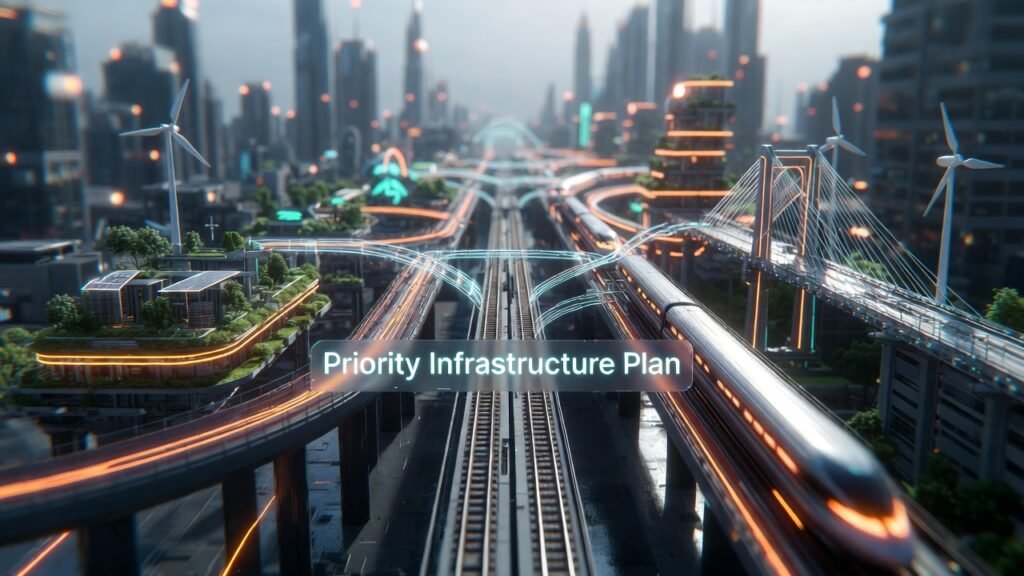
Infrastructure Sectors Covered in a Typical PIP
Modern PIPs are inherently multi-sectoral, reflecting the reality that communities need a full suite of services to function. The sectors typically addressed include:
- Transportation: Roads, arterial highways, public transit corridors, cycling and pedestrian networks, bridges, and freight infrastructure.
- Energy: Electricity distribution networks, substations, and increasingly, provisions for renewable energy generation and electric vehicle charging infrastructure.
- Water & Drainage: Water supply mains, sewerage systems, wastewater treatment capacity, stormwater drainage, and flood mitigation works.
- Digital Infrastructure: Broadband networks, fiber optic connections, and digital inclusion provisions for underserved communities.
- Social Infrastructure: Schools, hospitals, community health centers, libraries, parks, and affordable housing contributions.
Funding the Future: Financial Strategies for PIPs
A PIP is only as credible as its funding strategy. Infrastructure investment is capital-intensive, and the gap between what is needed and what any single level of government can afford from its own budget is almost always significant. Effective plans draw on a diverse mix of funding sources.
- Government budgets & grants: Federal, state, and local capital works budgets remain the primary funding vehicle for trunk infrastructure with broad public benefit.
- Developer contributions: In many jurisdictions, developers are required to contribute either financially or in-kind to the infrastructure their projects necessitate. This can take the form of a per-lot levy, a land dedication, or direct construction of assets.
- Public-private partnerships (PPPs): For large-scale projects such as toll roads or water treatment plants, PPP structures can draw in private capital in exchange for long-term operating rights.
- Infrastructure bonds: Governments can raise capital markets debt specifically tied to infrastructure projects, repaid over the asset’s useful life.
- Grants & special purpose funds: National and regional governments periodically offer competitive grants for infrastructure that meets specific policy objectives, such as climate resilience or digital inclusion.
Underpinning all of these is lifecycle cost analysis an accounting of not just construction costs but the ongoing maintenance, renewal, and eventual replacement of assets over a 30–50 year horizon. Plans that ignore lifecycle costs routinely create long-term fiscal burdens for local governments.
Overcoming Common Challenges in PIP Implementation
Even the best-designed Priority Infrastructure Plan will face obstacles during implementation. Anticipating these challenges is part of building a durable plan.
- Limited and volatile funding: Budget cycles, election cycles, and shifting government priorities can defund or delay projects mid-delivery. Mitigation strategies include securing multi-year funding commitments and building contingency budgets into cost estimates.
- Political shifts: Changes in government can lead to the reprioritization of projects for non-strategic reasons. Embedding the PIP in a statutory planning framework, rather than purely a policy document, provides greater continuity across political cycles.
- Procurement and delivery delays: Complex projects face procurement challenges specialist contractor availability, materials cost escalation, and regulatory approvals. Building realistic lead times and procurement strategies into the phased delivery plan reduces exposure.
- Community opposition: Infrastructure projects, particularly transport corridors and waste facilities, can generate significant community resistance. Early, genuine consultation not just notification is the most effective mitigation strategy.
- Cost overruns: Capital project cost overruns are common. Effective PIPs include reference-class forecasting (using historical data from comparable projects) and mandate independent cost reviews for major items.
Modern PIPs: Integrating Sustainability & Smart Technology
The most forward-looking Priority Infrastructure Plans today are grappling with two transformative forces: climate change and digital technology.
On the climate side, climate resilience and adaptation are being embedded directly into infrastructure design standards and project selection criteria. This means designing roads and drainage systems for more intense rainfall events, siting critical facilities outside flood-prone areas, and investing in green infrastructure urban tree canopies, permeable paving, and wetlands that provides both environmental and amenity benefits.
On the technology side, AI-driven planning and predictive analytics are enabling planners to model growth scenarios with greater precision, simulate the impacts of different investment sequences, and monitor infrastructure performance in real time through digital dashboards and sensor networks. Some jurisdictions are using digital twin technology a virtual replica of the urban environment to test PIP scenarios before committing to capital expenditure.
These advances are not merely technical upgrades; they represent a shift in the very nature of planning, from periodic, document-driven processes to continuous, data-informed management of complex urban systems.
Learning from Reality: A Brief Case Study
South East Queensland, Australia, provides one of the most cited real-world examples of a mature PIP framework. Facing significant population growth pressure from the 1990s onward, local and state governments developed a coordinated infrastructure planning regime that tied developer contributions directly to trunk infrastructure delivery programs. The framework included formally adopted PIPs for each high-growth council area, specifying the roads, parks, water mains, and community facilities that would be funded through a combination of developer levies and government capital programs.
The result was a system that could accommodate hundreds of thousands of new residents while maintaining agreed service levels, because the funding mechanism and the project list were established before development approvals were granted, not after. This sequencing infrastructure commitments before growth, not after is the core lesson that other rapidly growing regions around the world have sought to replicate.

Frequently Asked Questions About Priority Infrastructure Plans
What is the main purpose of a Priority Infrastructure Plan?
A PIP provides a structured, long-term strategy for delivering the infrastructure needed to support population and economic growth, ensuring investments are made in a prioritized, fiscally responsible, and coordinated way.
How are projects prioritized within a PIP?
Projects are scored against weighted criteria including urgency, health and safety risk, economic impact, strategic alignment, social and environmental benefit, and cost feasibility. The highest-scoring projects are scheduled earliest in the phased delivery plan.
What is a Priority Infrastructure Area (PIA)?
A PIA is the geographically defined zone within which a PIP’s infrastructure investments are concentrated typically aligned with areas designated for future urban growth in a local government’s land use strategy.
How long does a typical Priority Infrastructure Plan cover?
Most PIPs operate on a 10–20 year planning horizon, with detailed phasing for the first 5 years and broader indicative programs for later periods. Plans are typically reviewed every 5 years or when significant changes in growth forecasts occur.
What is the difference between trunk and local infrastructure?
Trunk infrastructure comprises the major backbone networks arterial roads, bulk water mains, trunk sewers that service large areas. Local infrastructure serves individual lots or small precincts and is typically the responsibility of the individual developer.
How are Priority Infrastructure Plans funded?
PIPs draw on a mix of government capital budgets, developer contributions, public-private partnerships, infrastructure bonds, and competitive grants. Most plans use a combination of these sources, allocated to projects based on who benefits most directly from the investment.
What happens if a city grows without a Priority Infrastructure Plan?
Without a PIP, infrastructure delivery becomes reactive and politically driven. The typical consequences are congested roads, overwhelmed utilities, underfunded community facilities, declining service levels, and ultimately a loss of investor and community confidence in the area’s governance.
Are Priority Infrastructure Plans legally binding?
This varies by jurisdiction. In some planning systems, an adopted PIP has statutory force it can be used as the legal basis for levying developer contributions and can be referenced in development assessment decisions. In others, it is a policy document that guides, but does not legally bind, decision-making. The degree of statutory backing significantly affects a plan’s durability across political cycles.
Who is responsible for creating and implementing a PIP?
Responsibility typically rests with local councils or regional government authorities, often in collaboration with state or federal agencies for major infrastructure like highways and hospitals. Larger plans may involve a dedicated infrastructure delivery authority.
How does a PIP address climate change and sustainability?
Modern PIPs embed climate resilience into design standards requiring infrastructure to withstand projected extreme weather events and use sustainability criteria as part of project prioritization. They also plan for green infrastructure and renewable energy integration as standard components of the infrastructure network.
What role does public feedback play in the planning process?
Public consultation is a critical governance step, ensuring that the plan reflects community priorities, surfaces local knowledge, and builds political legitimacy for the investment program. Most PIP frameworks require formal public exhibition and a structured response to submissions before a plan is adopted.
Can a Priority Infrastructure Plan be changed or updated?
Yes. Good PIPs are designed to be living documents. Most include a formal review mechanism typically every 3–5 years that allows the project list, phasing, and cost estimates to be updated in response to changes in growth forecasts, funding availability, or government policy.
Conclusion
Priority Infrastructure Plan is far more than an administrative document. It is the foundational commitment a community makes to its own future a declaration that growth will be managed thoughtfully, that public money will be spent where it delivers the greatest benefit, and that no new neighborhood will be left without the roads, water, schools, and digital connectivity it needs to thrive.
The most effective PIPs share common traits: they are rooted in rigorous data, built on genuine community engagement, backed by credible funding commitments, and designed to evolve as circumstances change. They treat climate resilience and equity not as optional add-ons, but as core design principles embedded from the outset.

Axurbain was founded to answer those questions. Led by Damiano Cerrone a specialist with more than a decade of experience spanning urban planning and digital innovation Axurbain operates as a media hub where professionals, students, architects, city planners, and curious urban enthusiasts come together to decode the complexity of modern cities. This is not just a blog. It is a living resource for anyone who wants to understand, shape, and celebrate the built environment.
Axurbain covers the art and science of architecture, the textures of urban living, the urgent imperative of sustainability, the power of renovation, the rise of smart cities, and the trends reshaping how we work, socialise, and dwell. Consider this your starting point for exploring it all.
What is Axurbain? Our Mission and Vision for Cities
At its core, Axurbain is built on a single conviction: cities are living ecosystems, not static backdrops. Streets change, skylines evolve, neighbourhoods rise and transform, communities form and dissolve. Understanding those dynamics and sharing that understanding in ways that are clear, visual, and genuinely useful is the mission that drives every article, interview, and analysis published here.
Axurbain’s vision goes beyond commentary. It aims to be an active participant in shaping how we think about cities, drawing on the latest research, real-world case studies, and the voices of practitioners working on the front lines of urban change. The platform welcomes professionals seeking deeper insights, students researching architectural theory, families navigating city life, and anyone who finds themselves looking up at a building and wondering why it was built the way it was.
The name itself is a fusion of “axis” and “urbain” a nod to the idea that urban life has many axes: economic, social, environmental, aesthetic. Axurbain sits at the intersection of all of them.
Core Themes We Explore
Axurbain organises its content around five interconnected pillars. Each one represents a dimension of urban life that is inseparable from the others you cannot talk about sustainable cities without discussing architecture, and you cannot talk about architecture without talking about the communities that inhabit it.
The Art of Architecture and Design
Architecture is the most public of all art forms. Unlike a painting hung in a gallery, a building shapes the daily experience of everyone who passes it whether they chose to or not. That responsibility makes architectural literacy not just interesting but essential.
Axurbain explores the full spectrum of design thinking. Biophilic design the philosophy of weaving natural elements like living walls, natural light, and organic materials into the built fabric is one of the most powerful antidotes to the alienation of dense urban living. Adaptive reuse, the practice of transforming existing structures rather than demolishing them, offers a creative and carbon-conscious alternative to new construction. Brutalism, often misunderstood, speaks to honesty of materials and monumental civic ambition. Postmodernism reacted against the rigidity of Modernism with playfulness and historical reference.
Design principles explored here include the manipulation of light and shadow, the psychology of spatial scale, the selection of materials for both performance and beauty, and the concept of human-centric design the idea that every space should be shaped first and foremost around the needs of the people who will inhabit it. Case studies of specific buildings, profiles of leading architects, and deep dives into design movements give readers not just information but genuine architectural fluency.
The Rhythm of Urban Living
City life is a paradox. It is crowded and lonely, stimulating and exhausting, expensive and culturally irreplaceable. Understanding the rhythms of urban living the daily rituals, the neighbourhood dynamics, the logistical challenges of compact spaces is a core part of what Axurbain offers its readers.
The content here ranges from the practical to the philosophical. How do you make a 45-square-metre apartment feel spacious? What makes a neighbourhood walkable, and why does walkability matter so deeply for mental health and community cohesion? How do diverse cultures layer over one another in a city block, producing something that is more than the sum of its parts? How do young professionals navigate the tension between the cost of city living and the opportunities it provides?
Axurbain approaches urban living not as a problem to be solved but as an experience to be understood and enriched. City guides, day-in-the-life features, and interviews with residents bring the human texture of urban life to the fore, reminding readers that behind every skyline are millions of individual stories.
Sustainability as a Standard, Not a Trend
The most important architectural question of our era is not aesthetic but ethical: how do we build and inhabit cities without destroying the planetary systems that sustain us? Axurbain treats sustainability not as a niche sub-genre of architecture but as its foundational standard.
Green rooftops and vertical gardens are not mere visual flourishes. They reduce the urban heat island effect, improve local air quality, manage storm water runoff, and provide habitats for urban biodiversity. Net-zero buildings, designed to produce as much energy as they consume, are rapidly moving from pilot projects to mainstream construction standards in progressive cities across Europe and North America. The Passive House standard, which achieves dramatic energy reductions through super-insulation and heat recovery ventilation rather than complex technology, demonstrates that radical sustainability can be elegantly simple.
At the city scale, the circular economy offers a powerful framework: keeping materials in use, eliminating waste, and regenerating natural systems. Sustainable materials bamboo, cross-laminated timber, recycled steel, low-VOC paints reduce the embodied carbon of new construction. LED lighting, smart thermostats, and IoT-driven energy management cut operational carbon in existing buildings. LEED certification and BREEAM standards provide auditable benchmarks for performance.
Axurbain covers the full spectrum: in-depth explainers for readers encountering these concepts for the first time, practical guides to eco-friendly habits and home upgrades, and cost-benefit analyses that help homeowners and developers make informed decisions.
Innovation and Technology Shaping Tomorrow’s Cities
The convergence of the physical and the digital is rewriting the rules of urban planning and design. Artificial intelligence, machine learning, and vast data streams are giving architects and planners tools that were unimaginable a generation ago. AI can model pedestrian flows across an entire city to optimise public space. It can analyse decades of energy consumption data to identify retrofitting priorities. It can enable real-time traffic management that reduces both congestion and emissions.
Smart home technology has brought the data-driven city into individual apartments and houses. IoT devices from smart thermostats that learn your schedule to energy monitors that give granular feedback on consumption make sustainable living measurably easier. Co-working spaces equipped with adaptive environmental controls and integrated digital infrastructure are blurring the boundary between home and office in ways that reshape entire neighbourhoods.
But Axurbain approaches these developments with nuance. The ethical implications of AI in cities are real and pressing. Algorithmic planning tools trained on historical data risk encoding historical biases into future infrastructure. Facial recognition and surveillance systems raise acute questions about privacy and civil liberty. The digital divide means that smart city benefits often accrue unevenly. Technology is a powerful tool, but tools require wisdom in their wielding. Axurbain covers both the promise and the complexity.

Key Urban Lifestyle Trends for 2025
Cities are laboratories of social change. The trends emerging in urban environments today give us the clearest preview of how society is evolving. Below are the trends that Axurbain considers most consequential right now.
| Trend | What It Is | Why It Matters |
| The 15-Minute City | Urban planning model where all daily needs are accessible within a 15-minute walk or cycle from home. | Reduces car dependency, lowers emissions, and strengthens local community bonds. |
| Urban Agriculture | Rooftop farms, community gardens, and vertical growing systems integrated into city fabric. | Shortens food supply chains, improves food security, and connects urban residents to ecological cycles. |
| Co-Working 2.0 | Flexible, tech-enabled shared workspaces embedded in residential neighbourhoods. | Eliminates long commutes, revitalises high streets, and supports the rise of distributed work models. |
| Biophilic Interiors | Incorporating plants, natural light, water features, and organic materials into indoor spaces. | Proven to reduce stress and improve cognitive performance in dense urban environments. |
| Smart Home Integration | IoT devices managing lighting, heating, security, and energy consumption via interconnected systems. | Empowers residents to reduce energy use and carbon footprint with minimal lifestyle disruption. |
| Inclusive Urban Design | Designing streets, parks, and buildings for the full spectrum of physical ability, age, and background. | Cities designed for everyone function better for everyone the economics of inclusion are well-documented. |
Renovation and the Circular City
Perhaps the most radical idea in contemporary urbanism is also one of the oldest: the best new building is one that doesn’t need to be built at all. Renovation and adaptive reuse the transformation of existing structures rather than their replacement are increasingly recognised as both the most sustainable and often the most culturally rich approach to urban development.
When an abandoned factory becomes a complex of design studios, co-working spaces, and community gardens, something extraordinary happens. The embodied carbon already locked into the building’s steel and concrete is preserved rather than wasted. The memory and character of the neighbourhood are honoured rather than erased. A new economic ecosystem emerges around a pre-existing urban anchor. This is what planners mean when they speak of “building cities within cities”.
Historic buildings renovated to contemporary standards of energy performance and accessibility demonstrate that the choice between heritage and progress is a false one. Interior makeovers from modest apartment refreshes to ambitious loft conversions form part of the same continuum. Axurbain covers the full range: step-by-step renovation guides, before-and-after case studies with budgets and timelines, and interviews with the architects and homeowners behind the most compelling transformations.
Starting Your Own Renovation Journey: Key Principles
- Define your brief clearly before engaging any contractor. Knowing what you want to achieve more light, better energy performance, additional space prevents costly scope creep.
- Assess the existing structure with a specialist before committing to a budget. Hidden problems in older buildings are common; contingency funds of 15–20% are standard practice.
- Think about embodied carbon. Retaining original materials where possible reduces environmental impact and often preserves authentic character.
- Prioritise fabric first: insulation, windows, and airtightness deliver the greatest long-term energy savings before any renewable technology is added.
- Document the process. Before-and-after photography and detailed records of decisions made are invaluable both for future occupants and for the wider community of practice.
Meet the Mind Behind Axurbain: Damiano Cerrone
Credibility in journalism and media is built on the shoulders of those who create it. Axurbain’s authority in the urban space flows directly from the expertise and vision of its founder, Damiano Cerrone.
With more than ten years of experience at the intersection of urban planning and digital innovation, Damiano brings a rare breadth of perspective to his work. His professional background encompasses both the analytical rigour of evidence-based planning and the communicative ambition of digital media. He understands how cities actually work how decisions made in planning offices translate into the lived realities of streets and squares and he has devoted his career to making that understanding accessible.
The philosophy that animates Axurbain is inseparable from Damiano’s own intellectual journey. Having worked across multiple European contexts, he brings an inherently comparative perspective to urban questions: what makes one city’s approach to housing affordability more effective than another’s? Why does public transport integration succeed in some cities while failing in others? What can the design of a park tell us about a society’s values?
His writing combines expert insights with genuine accessibility never dumbed down, but always crafted for a reader who may be encountering a concept for the first time. That commitment to clarity without condescension is the editorial DNA of Axurbain.

Frequently Asked Questions About Urban Living and Axurbain
What is Axurbain?
Axurbain is a media hub dedicated to urban living, architecture, and innovative design. Founded by Damiano Cerrone, it publishes articles, guides, case studies, and trend analyses that help readers understand and engage with the built environment.
Who is Axurbain for?
Axurbain serves a broad audience: architecture and design professionals seeking current perspectives, students and academics researching urban topics, city planners and policymakers, homeowners considering renovation or sustainability upgrades, and anyone who is curious about the cities they live in.
What is the difference between modern and contemporary architecture?
Modern architecture refers to a specific historical movement, roughly from the 1920s to the 1970s, characterised by functionalism, minimal ornamentation, and the use of industrial materials such as steel, glass, and concrete. Contemporary architecture simply means architecture being produced today it may draw on many different traditions and has no single defining aesthetic.
How can I make my apartment more sustainable?
Start with the fundamentals: draught-proofing and insulation improvements deliver the highest return. Switch to LED lighting throughout. Install a smart thermostat to optimise heating schedules. Reduce water consumption with low-flow fittings. Choose low-VOC paints and sustainably sourced materials for any renovation work. Composting and rigorous recycling complete a meaningful domestic sustainability programme.
What is a Passive House?
The Passive House standard is a rigorous energy performance specification for buildings. It achieves very low energy demand through super-insulation, high-performance triple glazing, elimination of thermal bridges, and a mechanical ventilation system with heat recovery. The result is a building that maintains comfortable temperatures year-round with minimal heating or cooling energy.
How is AI actually used in city planning today?
AI is being applied across a range of planning functions: modelling pedestrian and vehicle flows, optimising the routing of public transport networks, analysing land use data to identify development opportunities, simulating the impact of proposed developments on shadowing and wind patterns, and enabling participatory planning platforms where residents can engage directly with design proposals.
What are the benefits of green roofs?
Green roofs provide multiple overlapping benefits: they reduce the urban heat island effect by absorbing solar radiation that would otherwise heat hard surfaces; they manage storm water by absorbing rainfall and releasing it slowly; they improve air quality; they support urban biodiversity; and they extend roof membrane lifespan by protecting it from UV and temperature extremes. In residential settings they also provide amenity space and food growing opportunities.
Is eco-friendly renovation expensive?
The upfront costs of sustainable renovation can be higher than conventional approaches, but the long-term economics are typically favourable. Energy efficiency improvements reduce ongoing utility bills, often recovering their cost within five to ten years. Grants, loans, and tax incentives for green renovation are available in many jurisdictions and can significantly reduce upfront costs. Embodied carbon savings though not yet priced into most markets represent a real environmental value.
Join the Axurbain Community: Shape Better Cities Together
The future of our cities will not be decided by planners and architects alone. It will be shaped by the millions of people who live in them who choose to engage, question, advocate, and imagine something better. Axurbain exists to equip that collective imagination with the knowledge it needs.
Whether you are an architect looking for fresh perspectives on sustainable materials, a student writing your first dissertation on urban theory, a homeowner weighing a renovation against its environmental cost, or simply someone who finds the city endlessly fascinating, there is a place for you here. Explore the blog. Subscribe to the newsletter. Share the pieces that move you. Respond to the ideas that challenge you.

Briefly explain the common need to resize partitions (low disk space, new drive allocation) and state that this guide covers command-line tools (fdisk, parted, LVM) and GUI alternatives like GParted, with emphatic safety warnings to backup data.
Prerequisites: Backup, Planning, and Essential Checks
Stress the non-negotiable need to backup important data before any disk operation. This is the most critical safety step.
Identify Your Disk and Partition Layout
- Instructions for using lsblk, df -h, and sudo fdisk -l to identify disk (/dev/sda), partition numbers, current size, and mount points
- Keyword focus: check free space, partition number, disk identifier
Understand Your Partition Table and Tools
- Explain the difference between MBR (Master Boot Record) and GPT (GUID Partition Table) and why it matters for tool choice
- Briefly introduce the tools covered: fdisk, parted, growpart (simpler), and LVM suite
Method 1: Resizing a Standard (Non-LVM) Linux Partition
Introduce this method for common, direct partitions.
Option A: Using growpart and resize2fs (Recommended)
- Step 1: Install cloud-utils if needed (contains growpart)
- Step 2: Unmount the partition (sudo umount /dev/sdXY)
- Step 3: Grow the partition with sudo growpart /dev/sdX Y
- Step 4: Expand the filesystem with sudo resize2fs /dev/sdXY (for ext2/3/4) or sudo xfs_growfs for XFS
- Step 5: Verify with df -h
Option B: Using fdisk (Traditional Method)
- Detailed walkthrough: delete partition, recreate with larger size at same start sector, do not remove the signature, write changes
- Follow with filesystem expansion step (resize2fs)
- Include strong warning about data risk and exact sector alignment
Method 2: Resizing LVM (Logical Volume Manager) Partitions
Explain that LVM offers more flexibility and the process differs.
Step 1: Expand the Underlying Physical Volume (PV)
- If the VM/physical disk was enlarged first, use sudo pvresize /dev/sdXY
- Or, first use growpart as in Method 1
Step 2: Extend the Logical Volume (LV)
- Use sudo lvextend -L +20G /dev/YourVG/YourLV to add 20GB, or -l +100%FREE to use all space
- Introduce the -r flag to resize the filesystem simultaneously: sudo lvextend -l +100%FREE -r /dev/YourVG/YourLV
Step 3: Verify the LVM Resize.
- Commands: sudo lvdisplay, sudo vgdisplay, df -h
How to Shrink a Linux Partition (Advanced)
Warning: Shrinking is riskier and requires extra steps. The filesystem must be shrunk before the partition.
3: Step-by-Step Shrinking Process
- 1. Unmount & check filesystem (e2fsck -f)
- 2. Shrink the filesystem (sudo resize2fs /dev/sdXY M where M is new size)
- 3. Shrink the partition using parted (safer for this) or fdisk
Alternative: Using GParted Live USB (GUI Method)
Recommend this user-friendly method for beginners or complex operations.
Creating and Booting from GParted Live
- Instructions to download ISO, create bootable USB, and boot from it
Visual Resizing with GParted
- Describe the drag-and-drop interface, applying changes, and the visual safety of seeing the entire disk layout
Troubleshooting Common Resize Problems
“No Free Sectors” or “Partition Can’t Be Grown” Error
- Solution: Need contiguous free space; may require moving partitions (advanced, use GParted)
resize2fs Fails or Filesystem Errors
- Solution: Run full filesystem check (sudo e2fsck -f /dev/sdXY). Ensure partition is unmounted
LVM Commands Not Found or Volume Group Not Found
- Solution: Install lvm2 package. Ensure you are using the correct VG/LV names from sudo lvdisplay
Frequently Asked Questions (FAQ)
Can I resize my root (/) partition without rebooting?
Answer: No, the root partition must be unmounted. You must boot from a live USB/CD.
What’s the difference between resize2fs and lvresize?
Answer: lvresize/lvextend changes the LVM container size; resize2fs changes the ext2/3/4 filesystem inside it. The -r flag does both.
How do I resize a partition in a VirtualBox/VMware VM?
Answer: First, enlarge the virtual disk in VM settings. Then, inside the Linux guest, follow the steps in this guide to resize the partition to use the new space.
Is it safe to resize a partition? Will I lose data?
Answer: It is generally safe if you have a backup and follow instructions carefully. Data loss risk is low but never zero, hence the backup.

How can I resize a Linux partition in a Windows dual-boot setup?
Answer: Use a GParted Live USB. Shrink the Windows NTFS partition from within Windows first, then boot GParted to extend the Linux partition into the freed space.
SEO & Content Optimization Recommendations
To build a page that consistently outranks the current competition, implement these technical and structural recommendations:
| Recommendation | Details & Justification |
| Ideal Word Count | 1,800 – 2,500 words. This provides sufficient depth to cover all methods, safety information, troubleshooting, and FAQs comprehensively, signaling strong topical authority to Google. |
| Heading Structure | Use the H1-H4 outline above. Ensure each H2 represents a distinct, major topic cluster (Methods, Troubleshooting, FAQs). This creates a clear information hierarchy for users and search engines. |
| Paragraph Structure | Keep paragraphs concise (2-4 sentences). Use bulleted or numbered lists for commands and steps to improve scannability. Mix medium-length explanatory paragraphs with short, directive lists. |
| Internal Linking | Link to related internal pages: “Linux Disk Management Guide,” “How to Backup Linux with Rsync,” “Dual-Boot Installation Guide.” Use descriptive anchor text like “learn more about LVM basics” instead of “click here.” |
| On-Page SEO Improvements | Image Optimization: Include 2-3 annotated screenshots (e.g., lsblk output, GParted interface). Use descriptive alt text (“GParted interface showing extended Linux partition”).Code Blocks: Display all terminal commands in formatted code blocks with syntax highlighting for readability and copy-paste ease.Featured Snippet Targets: Structure key answers (like the growpart steps) in a clear, numbered list. Answer FAQs in a concise, direct paragraph to target People Also Ask boxes. |
| Additional Trust Signals | Include a “Last Updated” date.Add a clear “Warning: Backup Your Data” notice at the top.Mention tested-on sections (e.g., “Tested on Ubuntu 22.04 LTS and Fedora 38”). |
Next Steps
You can use the detailed outline as your content blueprint. To begin, focus on fleshing out the H2: Method 1 section with clear, error-checked commands.
For questions or elaboration on any section of this analysis, or to generate detailed prose for specific parts of the outline, please reach out.
-

 BLOG8 months ago
Shocking Gasp GIFs – Top 9 Picks
-

 BLOG6 months ago
Is Recurbate Safe for Users or a Hidden Risk?
-

 ENTERTAINMENT6 months ago
Top Uwufufu Best Songs for Playlists and Parties
-

 BUSINESS8 months ago
Budget Connect: The Smartest Business Phone Service for Less
-

 ENTERTAINMENT6 months ago
Peter Thiel Email: Safe and Verified Contact Methods
-

 BLOG9 months ago
Mark Spaeny: Tailoring Success and Raising a Star
-

 ENTERTAINMENT8 months ago
Twitter Rate Limit Exceeded: What It Means and How to Fix It Fast
-

 TECH9 months ago
Quick Guide: How to Easily Reset Your Acer Laptop